
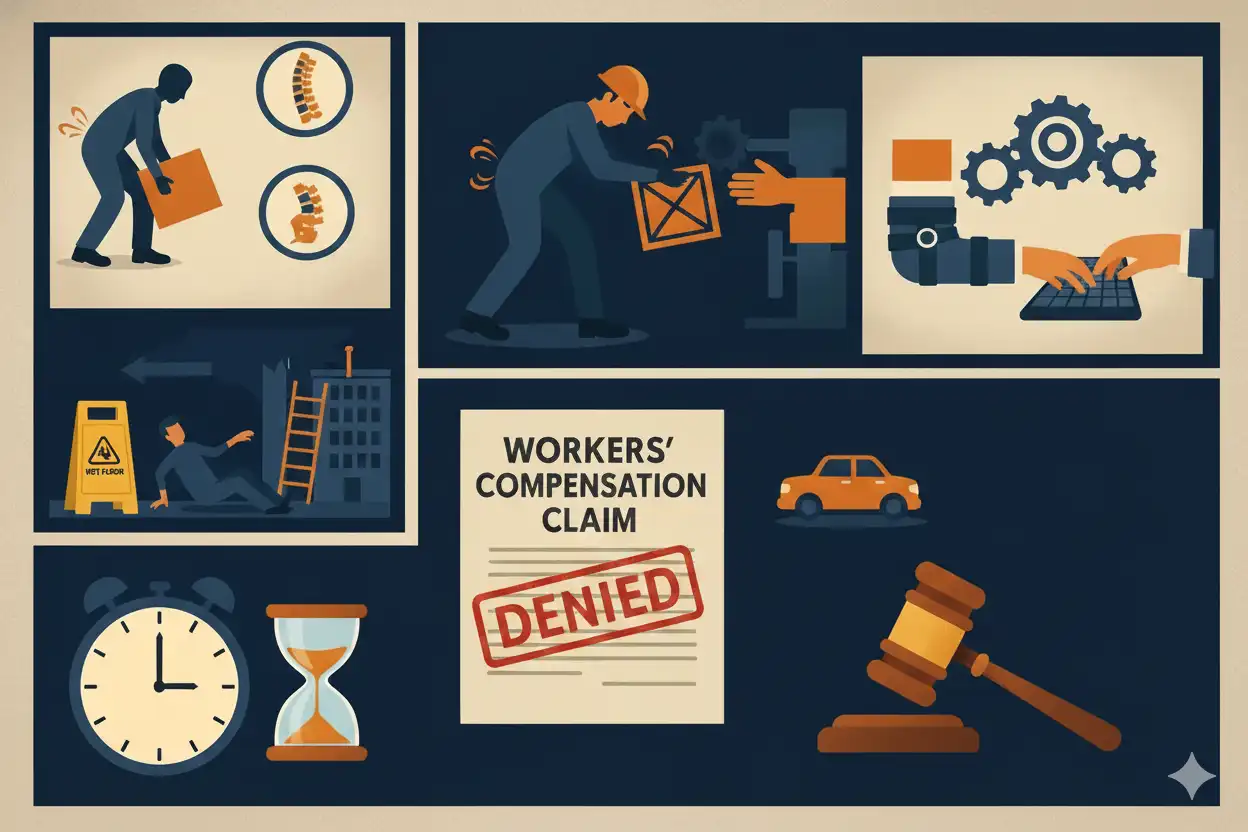
The majority of on-the-job injuries fall into three key categories. Understanding these categories is the first step in determining the legal nature of your workers' compensation claim.
In North Carolina, not all injuries are treated the same way under the law.
To be compensable under the North Carolina Workers' Compensation Act (Chapter 97), an injury must generally be an “injury by accident arising out of and in the course of the employment.” This means there must be some unexpected event that interrupted the normal work routine.
*Back Injury Exception: For a back injury to be covered, it must be the “direct result of a specific traumatic incident of the work assigned,” regardless of whether there was a general accident. This is a critical distinction in NC law.
A disease is typically covered only if it is an occupational disease caused by exposure to harmful conditions or substances unique to the workplace, such as asbestos, lead poisoning, or certain cancers. Repetitive Strain Injuries (RSIs) like carpal tunnel syndrome are often pursued as occupational diseases because they develop over time, not from a single accident.
While visible injuries are generally straightforward, conditions that manifest over time, such as Repetitive Strain Injuries (like Carpal Tunnel) and certain Toxic Torts (diseases from long-term chemical exposure), can be the hardest injury to prove because the victim must legally connect the injury to their job duties over an extended period.
Many common workplace injuries are a direct result of safety failures. OSHA's most frequently cited standards highlight where employers most often fail to protect employees. The top three hazards consistently cited by OSHA are:
The most common causes of accidents, including Fall Protection and Hazard Communication, directly correlate with the top types of personal injury cases and accidents we see.
When you suffer one of the most common workplace injuries or an occupational disease, your legal recourse generally involves two avenues:
This is a no-fault system. You do not have to prove your employer was negligent.
This is an exception to the exclusivity rule. If your injury was caused by the negligence of a party other than your employer or a co-worker, such as a defective machine manufacturer, a property owner (if you are a tenant/contractor), or a negligent driver on a job-related route, you can file a personal injury lawsuit against that third party.
Compensation: A successful personal injury claim against a third party allows you to recover damages not available under workers' comp, including pain and suffering and full damages for emotional distress.
For more information on the distinctions in NC law, you should review our Guide to Personal Injury Law in North Carolina.
Whether your case is a standard overexertion injury or a complex third-party action, the time limit for filing a claim is strict. If you've suffered one of the most common workplace injuries in the Raleigh, Durham, Apex, or Cary areas, don't leave your compensation to chance.
Contact Paul Robinson Law, P.L.L.C. today for a free consultation. We'll help you navigate the NC Workers' Compensation Act and fight for the full benefits you deserve.
Call Us At
919-438-0065
105 S Ellington St, Clayton, NC 27520
124 St Marys St Ste 201, Raleigh, NC 27605
800 W Williams St #250 Apex, NC 27502