
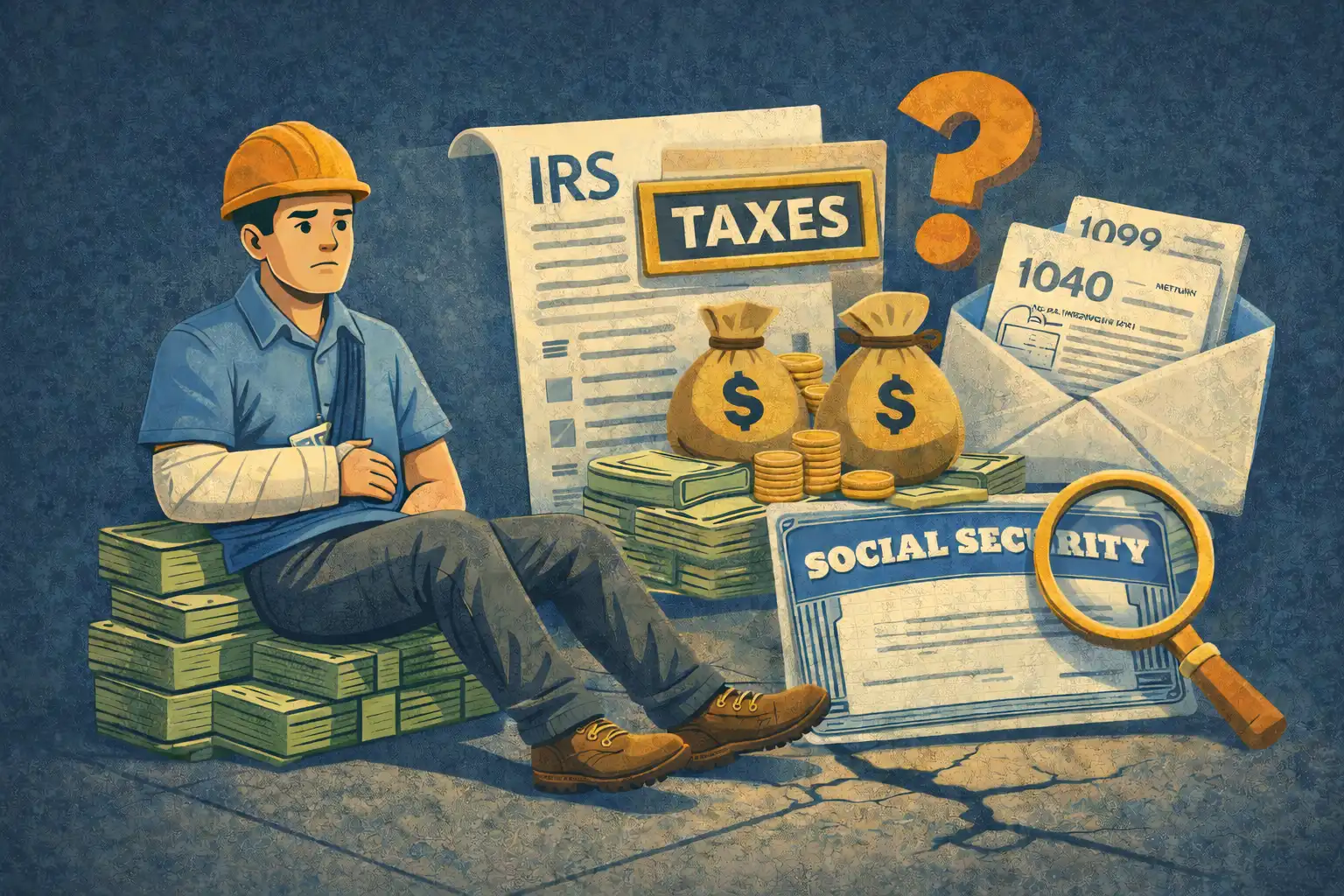
If you have been sidelined by an injury on the job in Raleigh, Cary, or the surrounding areas, your focus should be on recovery, not worrying about a surprise bill from the IRS. One of the most common questions we hear at Paul Robinson Law, P.L.L.C. is: Do I have to pay taxes on my workman's comp?
For the vast majority of injured workers in North Carolina, the answer is a relief. However, there are specific financial intersections, particularly regarding Social Security and settlement interest, where the tax rules become more complex. This guide clarifies the tax status of your benefits so you can plan your financial future with confidence.
According to IRS Publication 525, amounts you receive as workers' compensation for an occupational sickness or injury are fully exempt from tax if they are paid under a workers' compensation act or a similar statute.
In North Carolina, these benefits are governed by the North Carolina Workers’ Compensation Act (NCGS Chapter 97). Because these payments are intended to provide financial relief for medical bills and lost wages rather than traditional "earned income," they are not subject to:
No. Since these benefits are non-taxable, insurance carriers typically do not issue a W-2 or 1099. You generally do not need to report these payments on your tax return at all.
Many of our clients eventually reach a point where they choose to "clinch" or settle their case. Whether you receive your benefits in weekly installments or as a lump sum workers' comp settlement, the tax-exempt status remains the same.
However, you should be aware of two specific "tax traps" that can arise during a settlement:
This is the most significant exception to the tax-free rule. If you are receiving both workers' compensation and Social Security Disability Insurance (SSDI) or Supplemental Security Income (SSI), the Social Security Administration may reduce your monthly disability check. This is known as the "Social Security Offset."
Under federal law, the total combined amount of your workers' comp and Social Security benefits cannot exceed 80% of your average current earnings before you became disabled.
If your Social Security benefits are reduced because of workers' comp, the amount of the reduction (the offset) can actually be treated as taxable income. Essentially, the IRS may tax the portion of your workers' comp that "replaced" your taxable Social Security benefits. This is a complex calculation where having an experienced attorney is vital to ensure your settlement is structured to minimize this offset.
Understanding your rights under NCGS Chapter 97 is the first step toward a successful claim.
If you are a business owner or are reviewing an income statement, workers' compensation insurance premiums are typically listed as an operating expense. For the individual recipient, however, these benefits do not appear on an income statement as "revenue" or "salary" because they are a form of compensatory insurance reimbursement, not traditional income.
The intersection of insurance, tax law, and disability benefits is a minefield for the unprepared. At Paul Robinson Law, P.L.L.C., we have years of experience representing clients in Raleigh, Durham, Apex, and Cary. We don't just fight for a check; we work to ensure your settlement is structured to protect as much of your money as possible from offsets and taxes.
If you are navigating a claim, don't go it alone. We can help you understand how to file a workers' compensation claim in North Carolina or provide guidance on what to do if your workers' compensation claim is denied.
Contact Paul Robinson Law today for a free, no-obligation consultation. We’ll review your case and help you understand the true impact of workers' comp on your financial future.
Call Us At
919-438-0065
105 S Ellington St, Clayton, NC 27520
124 St Marys St Ste 201, Raleigh, NC 27605
800 W Williams St #250 Apex, NC 27502