
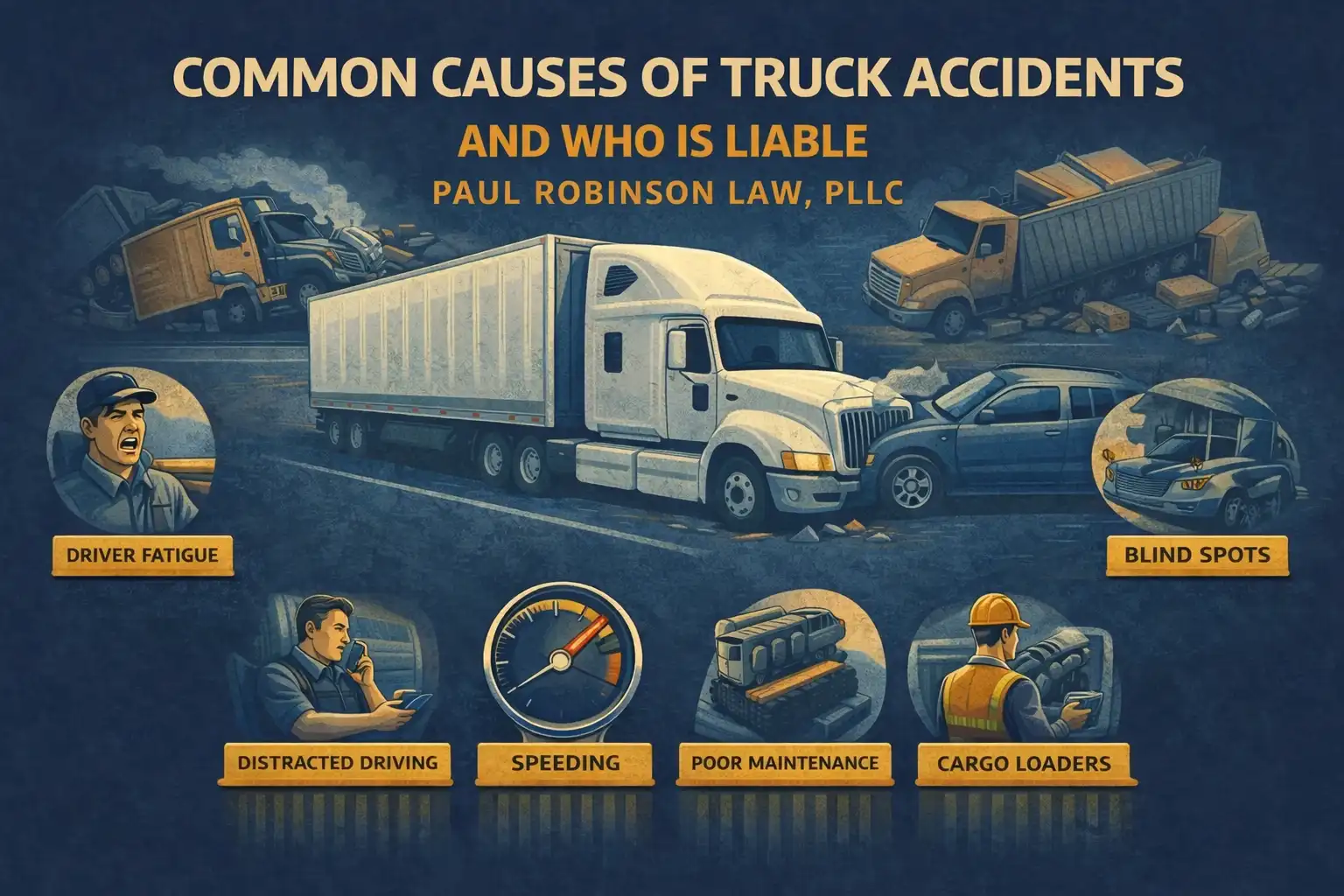
When a passenger vehicle collides with a commercial truck, the results are often life-altering. Due to the massive weight and size of tractor-trailers, a truck accident injury is frequently catastrophic. Understanding what are the most common causes of truck accidents is essential for victims seeking to hold negligent parties accountable in Raleigh and across North Carolina.
At Paul Robinson Law, P.L.L.C., we represent individuals injured in commercial driving accidents. These cases are more complex than standard car accidents because they involve federal regulations, multiple layers of insurance, and diverse liable parties.
Data from the Federal Motor Carrier Safety Administration (FMCSA) indicates that most crashes involving large trucks are caused by human error. In fact, research suggests that the "critical reason" for nearly 87% of these crashes is attributed to the driver.
Liability in a truck accident is rarely limited to the person behind the wheel. Depending on the truck accident causes, several parties may be financially responsible:
If you are involved in a collision with a commercial vehicle, North Carolina law establishes clear mandates for all involved parties. Under N.C.G.S. § 20-166, the driver of any vehicle who knows or reasonably should know they are involved in a crash must:
Failure to comply with these duties can result in serious criminal penalties, ranging from misdemeanors to Class F felonies, depending on the severity of the injuries involved.
Understanding the scope of the problem helps highlight the risks on North Carolina highways like I-40 and I-85.
While truck accidents impact all demographics, national data suggests that approximately 71% of people killed in large truck crashes are occupants of other passenger vehicles.
The trucking industry is predominantly male (over 80%). Consequently, men account for the vast majority of commercial driver fatalities.
What is the number one killer of truck drivers? Statistically, motor vehicle crashes are the leading cause of work-related deaths for truck drivers. However, when looking at long-term health, heart disease and lifestyle-related illnesses also rank significantly high due to the sedentary nature of the job.
The leading cause is generally categorized as "driver recognition" or "decision" errors, such as speeding or failing to see a vehicle in a blind spot.
North Carolina follows the rule of contributory negligence. If you are found even 1% at fault for the accident, you may be barred from recovering damages. This makes hiring a skilled Raleigh truck accident lawyer vital to protect your claim.
You can explore our Guide to Personal Injury Law in North Carolina or see our post on the Most Common Types of Personal Injury Lawsuits.
If you have suffered a truck accident injury, the clock is ticking. Evidence like electronic logging data (ELD) and "black box" recorders can be deleted or overwritten quickly. At Paul Robinson Law, P.L.L.C., we move fast to preserve evidence and build a case for the compensation you deserve.
Contact us today for a free consultation. We serve clients in Raleigh, Cary, Durham, Apex, and surrounding communities.
Call Us At
919-438-0065
105 S Ellington St, Clayton, NC 27520
124 St Marys St Ste 201, Raleigh, NC 27605
800 W Williams St #250 Apex, NC 27502